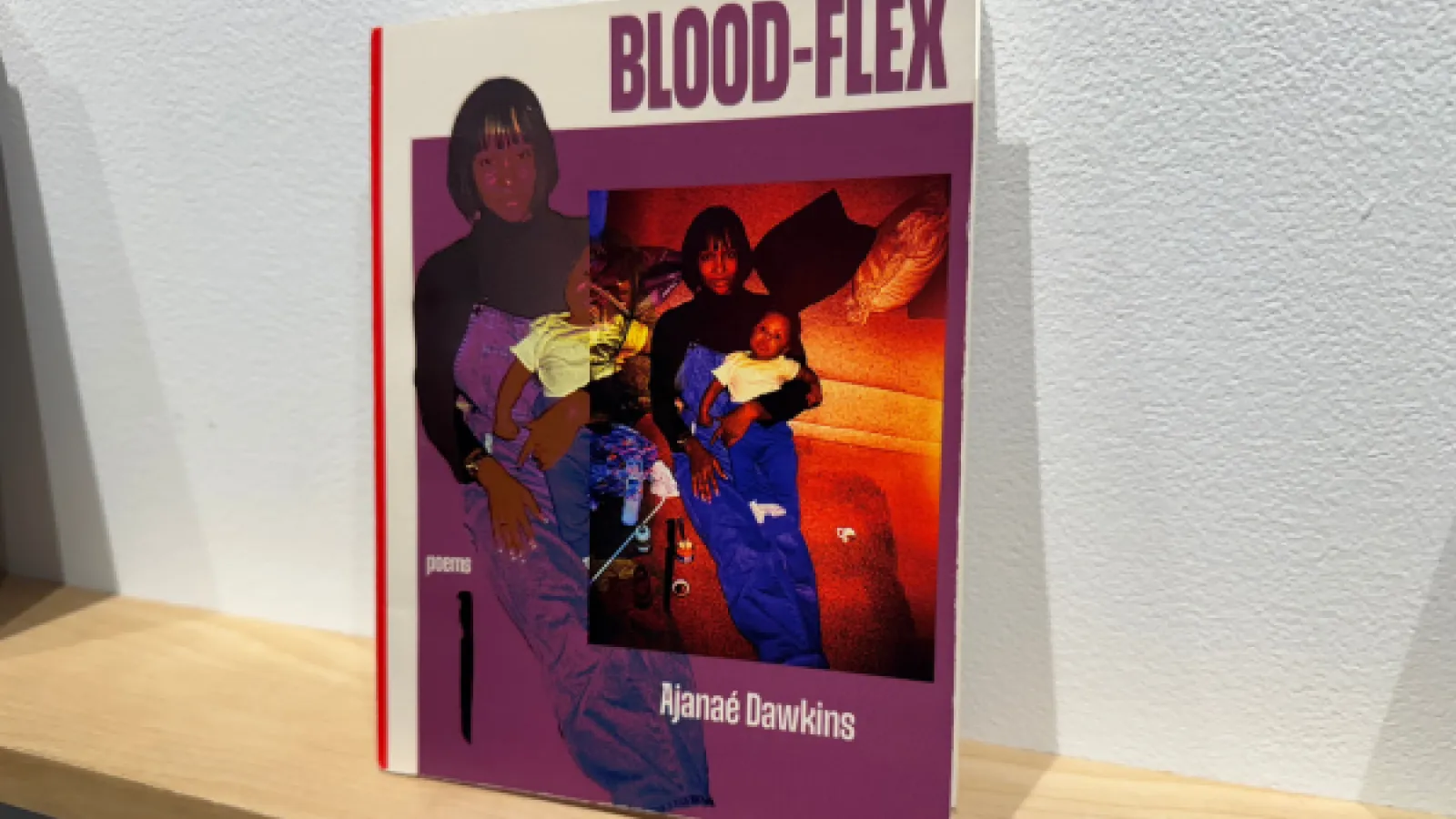
BLOOD-FLEX by Ajanaé Dawkins Explores Mother–Daughter Relationships Through Poetry

"A daughter / observes until her eyes are blood-thick with / history," writes Ajanaé Dawkins in Blood-Flex, the author's debut chapbook. In this collection, Dawkins dissolves the clouded vision of inheritance, examining her relationship with her mother through a grown and introspective lens. These lyrical and honest poems address the hereditary pains of womanhood, creating a meditation on memory, heartbreak, and the bond between mothers and daughters.
Across its twenty-three poems, Blood-Flex comforts any daughter who has a complicated relationship with her mother, which is perhaps all of us. Vignettes of Dawkins’s childhood, adolescence, and young adulthood show how maternal relationships are continuously shaped and reformed. These situations highlight how we grow to understand what it truly means to be a woman in a society riddled with systemic violence and social injustices. They are framed through the use of universal experiences and clever titles, such as in "Girlhood Ritual #7," where Dawkins describes how "My awkward and unsexed body / performed desire from no memory."
The collection acknowledges and captures the moments when we exist between girlhood and womanhood, between forgiveness and resentment, and between understanding and confusion. Dawkins's tender language and use of body imagery convey the experience of both emotional and physical growing pains.
Dawkins also draws attention to the universal disconnect in what we perceive as either feminine or maternal traits. As adolescents, and sometimes well into adulthood, we fail to see how these two dispositions can overlap. Over time, this perception can perpetuate the divide between mother and daughter. Dawkins recounts a story of a daughter who got in trouble for staying out late partying with friends. She writes of the mother, "...even she forgot she had been a woman before she was my momma."
This line expresses one of the collection's central tensions: the way motherhood can eclipse a woman's other identities, both in her own perception and in her daughter's eyes. In moments like this, as teenagers, we remarked that no one understood us, but it was often the case that our mothers understood us too well. The tragedy lies in our inability to see past the maternal role to the person beneath.
But how, in our clouded eyes, are we supposed to see how our mothers were once just like us? When in our womanhood do we begin to forgive our mothers for simply surviving in a society that forced upon them a life that we don't want to inherit? Dawkins tackles this question in "Final Poem for my Mother": "I am crafting you a tongue. I am gathering / ears. I am sewing my mouth shut with a steady hand. Now I know / how memory is communal and not a gun."
With this poem, Dawkins resigns herself to history, to inheritance—but not in defeat. With maturity, she begins to see her mother's memories not as a sentence, but as a lesson. The image of crafting a tongue and gathering ears suggests an act of reconstruction, of creating new ways to listen and to accept the sometimes painful work of archiving.
Blood-Flex creates space for understanding our mothers as women who had to get by just like us. It's a collection that testifies to the hard work of acknowledging both the wounds and the love that shaped them. Dawkins has created a powerful chapbook that speaks to anyone seeking to understand how we carry and transform the inheritance we've been given. Ultimately, it is a collection about growing up, and the hard realities that come with it. Realities that make us seek out knowledge we might find in our mother’s memory.
“Now I negate my adulthood at will, — calling you for all inconveniences [...] Mom, what do I tell / the mirror? The man misplacing my personhood? The self / who let him?”