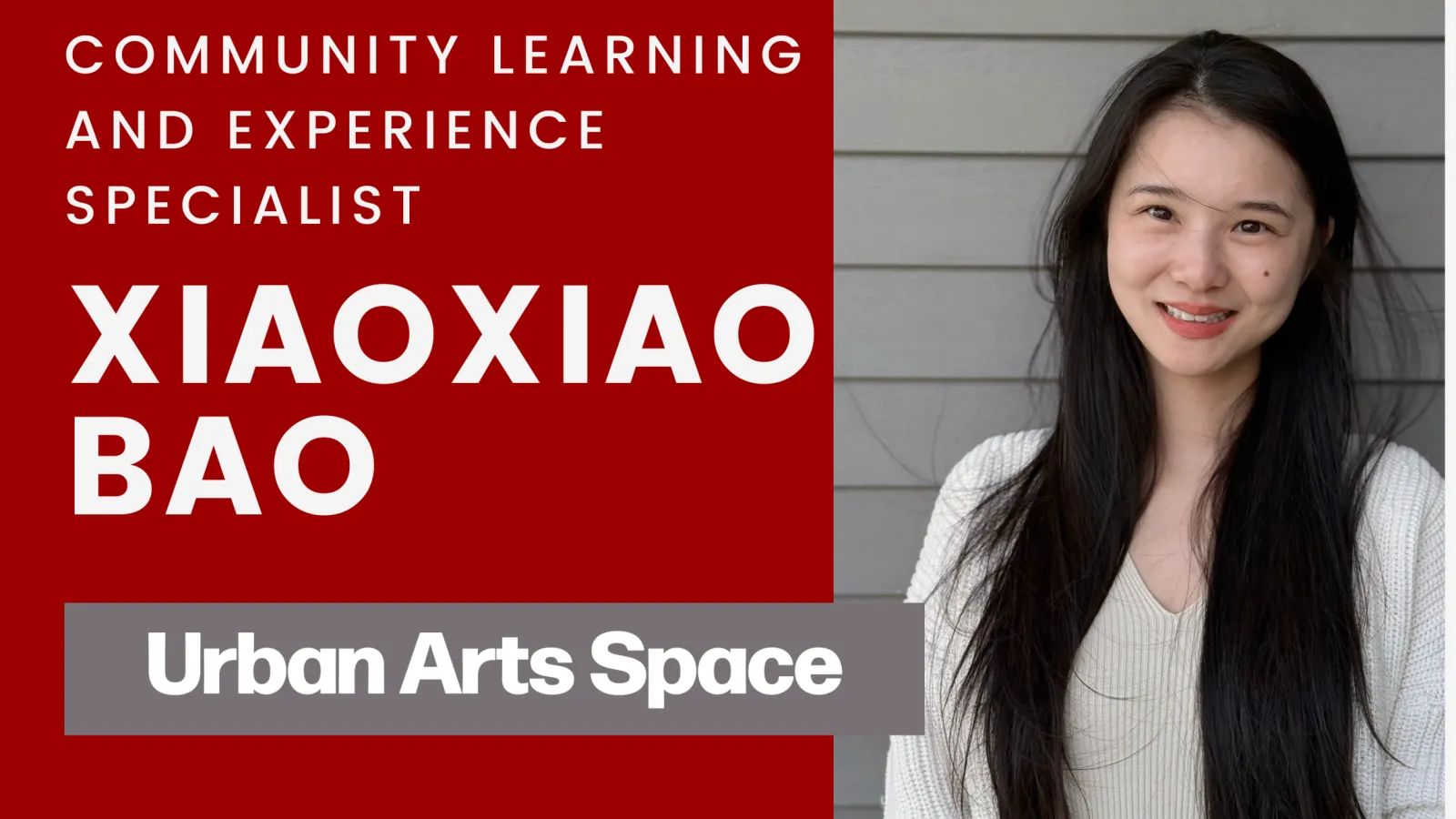
Introducing Xiaoxiao Bao, Urban Arts Space's New Community Learning and Experience Specialist

Urban Arts Space is excited to welcome the newest member of our team—Dr. Xiaoxiao Bao, our Community Learning and Experience Specialist!
Xiaoxiao arrived in Columbus in 2019 after a seven-day road trip from California, and has since earned both an M.A. in Art Education and a Ph.D. in Arts Administration, Education and Policy from The Ohio State University. Her dissertation explored how socially engaged artist residencies surface everyday local stories, foster sustained engagement in the arts, and support community building in under-resourced neighborhoods. Her work has been recognized with the Art Education Research Institute (AERI) Graduate Research Award in 2023 and the Manuel Barkan Dissertation Fellowship Award in 2025.
With professional experiences in galleries, museums, nonprofits, and college classrooms, Xiaoxiao has built her career at the intersection of research, arts administration, and education. As the Community Learning and Experience Specialist at the Urban Arts Space, she is interested in bridging gaps between curation and education to develop community-centered programs where everyone feels welcomed and reflected.
We invited Xiaoxiao to share more about her love for the arts and the community as well as her hopes for this new role.
What draws you to the arts?
I grew up attending a martial arts boarding school with very limited access to art of any kind. So when I came across Édouard Manet’s The Fifer in an elementary school music textbook, I was struck by how a painted figure could feel so alive—it was magical. That experience of how art could reach across time to its audience stayed with me, but it wasn't until high school that I had the chance to explore it more formally through studio training.
The second moment that drew me into the theoretical aspects of art occurred in an introductory art history course in the U.S., where I encountered Marcel Duchamp’s Fountain. That work unsettled me and made me question what defines art and who gets to make that call. I felt very compelled to find answers in interpreting the work, so I pursued art history in college and went on to work at nonprofit organizations, institutional galleries, and an auction house to explore how that knowledge could be applied.
At the same time, I increasingly felt a distance between myself and the discipline, as my own culture and its contemporary moment were largely absent from it. This changed when I watched a group of local children engage actively with Martin Wong’s solo exhibition at the Berkeley Art Museum and Pacific Film Archive (BAMPFA) in 2017. Seeing how Wong’s work bridges culture, memory, and communities, and how meaningfully those kids connected with it, made me realize that what attracts me most to art is its power to bring people together. The encounter at BAMPFA was my aha moment of seeing art as a social practice that drew me toward becoming a community-centered art educator.

What are you most looking forward to in your new role?
Having worked at Urban Arts Space as a graduate associate in summer 2023, I got firsthand experience of how long-term planning comes to life as lively community engagement, and I loved being challenged to bring all of my skills to what was happening both inside and outside the organization. I am excited to have this opportunity to return to the collaborative team and work alongside my colleagues, familiar and new, to bring programming that is relevant and engaging to our campus and community audiences.
I’m also looking forward to working with a diverse group of interns (there are 58 of them!) and community partners across Columbus. It’s important to me to contribute to the interns’ learning and experiences while facilitating community engagement in ways that feel truly reciprocal and build sustained relationships.
How do you personally define community?
For me, community is a collective grounded in the everyday as something steady and made up of many ordinary moments. Through both my work and research, I’ve come to understand that community is built through small, informal acts of connection such as brief conversations, gestures of care, and moments of shared understanding. Over time, these interactions accumulate into trusted relationships that open the door to collaboration and greater engagement. This perspective informs the way I see engagement not as a one-time outcome but as an ongoing, everyday process that is sustained through consistent presence and the cultivation of conditions that enable mutual learning and exchange.
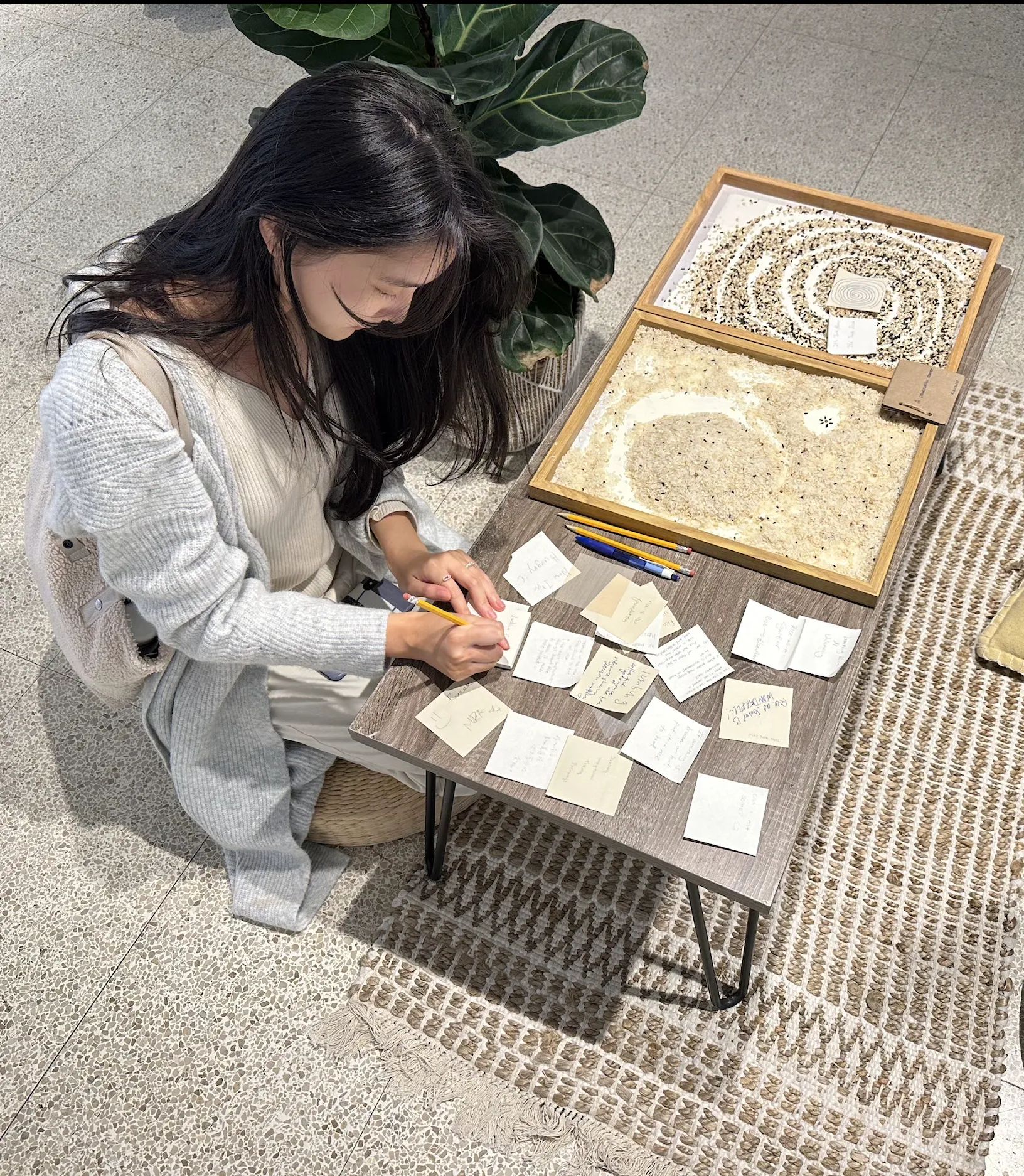
What do you do for fun outside of work?
I enjoy designing and building things myself. Throughout my doctoral studies, it became something of a yearly tradition to pick up a new hands-on hobby. Over the years I’ve tried soft oil pastel painting, needle felting, which I find incredibly stress-relieving, and sewing. I’ve also made pipe cleaner bouquets, which actually grew out of facilitating public engagement activities with youth at Urban Arts Space. Growing houseplants has been my longest-running and most successful hobby. My fiddle leaf fig tree has been with me for five years, and it has made an appearance at the trace layer play 3 exhibition in 2023 at Hopkins Hall Gallery, where it became quite the companion for everyone there. These days I’d love to pick up tennis again as the weather gets warmer and learn some kind of dance.
Who in your life inspires you?
My MA and PhD advisor, Dr. Joni Acuff, has been a profound influence on both my academic and professional paths. Over the past six years, she has consistently created space for me to work through the challenges I encountered in research and in life. Her constructive feedback on my dissertation chapters always left me with a clear sense of how to improve and a growing confidence in my own potential. I initially applied to the AAEP program because of Dr. Acuff’s scholarship in culturally relevant pedagogy and critical multicultural art education; over time, her work has influenced how I consider the intersections of art, justice, and community in everything I do.
My older sister inspires me just as deeply. She was the one who first opened the door for me to study abroad and has supported me unconditionally at every step since. She is a dedicated scholar, an incredible mother of three, and a tireless source of support for our whole family. Watching the way she shows up so fully and generously for those around her has expanded my understanding of resilience, care, and what it means to be truly present for others.