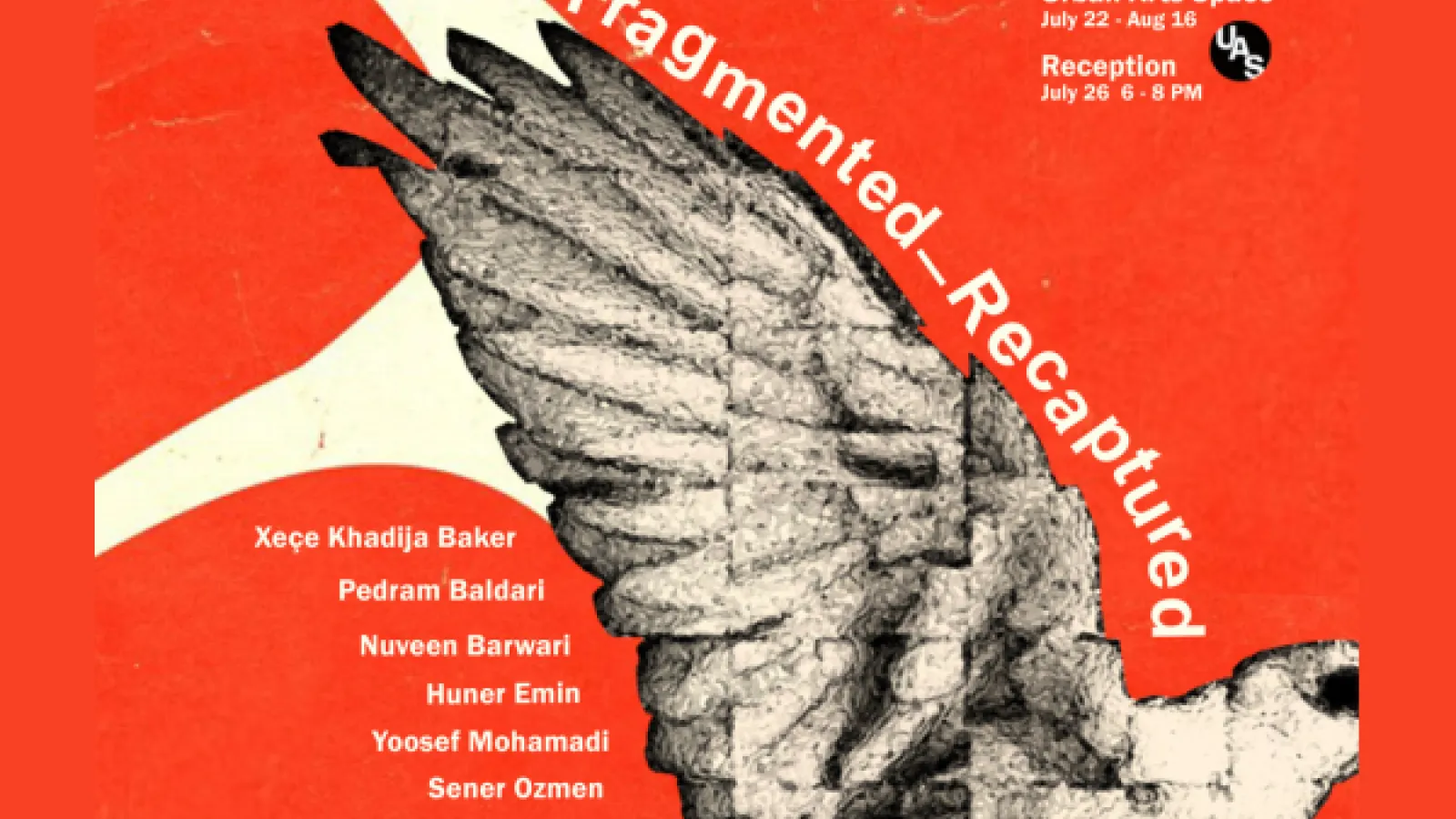
Fragmented-Recaptured is a coalescing dialogue between a group of artists residing in North America whose diasporic experiences are tethered by a common yet fragmented identity as Kurds. The works on display interrogate histories and modalities of marginalization and the systemic minoritization of the Kurds, the largest stateless nation within the socio-political borders of the states (Iran, Iraq, Syria, and Turkey) that rule over a part of their homeland Kurdistan. The exhibition navigates shared narratives of displacement, conflict, and resistance, offering a deeply personal yet collective lens on the Kurdish experience recaptured through the new forms of diasporic conversation.
Reception: Saturday, July 26, 6–8 PM
Participating Artists: Xeçe Khadija Baker, Pedram Baldari, Nuveen Barwari, Huner Emin, Yoosef Mohamadi, Sener Ozmen, Sahar Tarighi
More About the Show
Interweaving a diverse range of media such as video, installation, sculpture, and drawing, Fragmented–Recaptured interrogates histories and modalities of marginalization and the systemic minoritization of the Kurds. The socio-historical context behind this show's aesthetic landscape and conceptual framework emerges from a century-long Kurdish struggle against the systemic erasure of a national and epistemological identity. This identity has been criminalized and securitized through various state-sanctioned modes of violence.
Kurdish fragmentation is not accidental but the result of enduring geopolitical turmoil, beginning with early 20th-century imperial interventions. The Sykes-Picot Agreement of 1916—a secret pact between Britain and France—arbitrarily carved up lands previously occupied by the Ottoman Empire into colonial spheres of influence, disregarding the region’s ethnic or cultural landscapes. This agreement laid the foundation for the division of Kurdistan across emerging nation-states. Later, the Treaty of Lausanne in 1923 erased earlier international promises of Kurdish autonomy, officially recognizing the territorial integrity of the modern Turkish Republic while dissolving any legal pathway toward Kurdish statehood. These decisions resulted in the partition of Kurdistan into four parts—dispersing the Kurdish people across Turkey, Iraq, Syria, and Iran—and sowing the seeds of a century-long struggle for recognition, cultural survival, and political self-determination.
Each artist in this exhibition has been subjected to the rule of one of the aforementioned states. Each of these states has, within the last hundred years—and as recently as 2018—committed massacres, genocide, ethnic cleansing, and forced displacement against its Kurdish population. Each artist in this show has experienced exile due to the systemic persecution of their communities, directly or indirectly, by these states. What most of these states share in common is an imposed nationalism centered on the erasure of the Kurdish language, cultural existence, aesthetic epistemology, and historical aspirations. We have all been denied our mother tongue and forced to learn the imposed “official language” of the states that have colonized a part of Kurdistan. Arabization, Persianization, and Turkification of Kurdish visual references have been part of ongoing forms of epistemicide, severing them from thousands of years of historical roots in the region.
Through the diasporic condition and emerging communication technologies, new possibilities have surfaced for Kurds to rethread a torn net of solidarity and reimagine a shared future. In most archives, books, and museum collections, Kurdish visual heritage, references, and precedents of aesthetic modes of production have been categorized as belonging to the nation-states that claim Kurdish histories as Arabic, Persian, or Turkish.
This exhibition recaptures the artists’ reflections on lived experiences and their endurance in the face of a continued systemic corrosion of deeply rooted belonging—to land, to people, and to the visual-epistemic references that define such a complex form of existence. What tethers the works on display—despite their vast differences in medium, material, process, and creative modality—is a note of longing, a mode of sense perception that facilitates connection to a land called Kurdistan.
On official governmental papers, the artists in this show carry Iranian, Iraqi, Syrian, or Turkish nationalities. Within these states, they have been “educated,” “integrated,” “assimilated,” “indoctrinated,” and “urbanized” under categorically different epistemic regimes, often at odds with one another in their historical and political narratives. These policies are designed to homogenize socio-political, aesthetic, visual, linguistic, and historical references, flattening anything challenging the dominant narratives imposed upon Kurdish identity.
This systemic and institutionalized erasure—aimed at alienating Kurdishness while glorifying state-generated notions of “nationalism” and “identity”—continues to be problematized and challenged through forms of solidarity that connect Kurds via a shared struggle and familiar modes of existence. These modes surpass colonial political borders and carry forward a long-standing resistance through creative practices, songs, dances, patterns, symbols, plants, knowledge-sharing traditions, and reimaginings of possible futures grounded in self-determination, healing, love, and, hopefully, art.
Visiting Urban Arts Space
50 W. Town St., Ste. 130
Columbus, OH 43215
Located in the historic Lazarus Building in downtown Columbus.
Hours
Tuesday–Saturday | 11 a.m.–6 p.m., with extended hours until 8 p.m. on Thursday.
Admission to our exhibitions and programs is free!
View this map for parking garage options, with street parking on Rich, Front, and Wall Street, or go to our Accessibility page for bike or bus directions.