796 Innocents: An Interview with Mia Sweeney Gahrmann
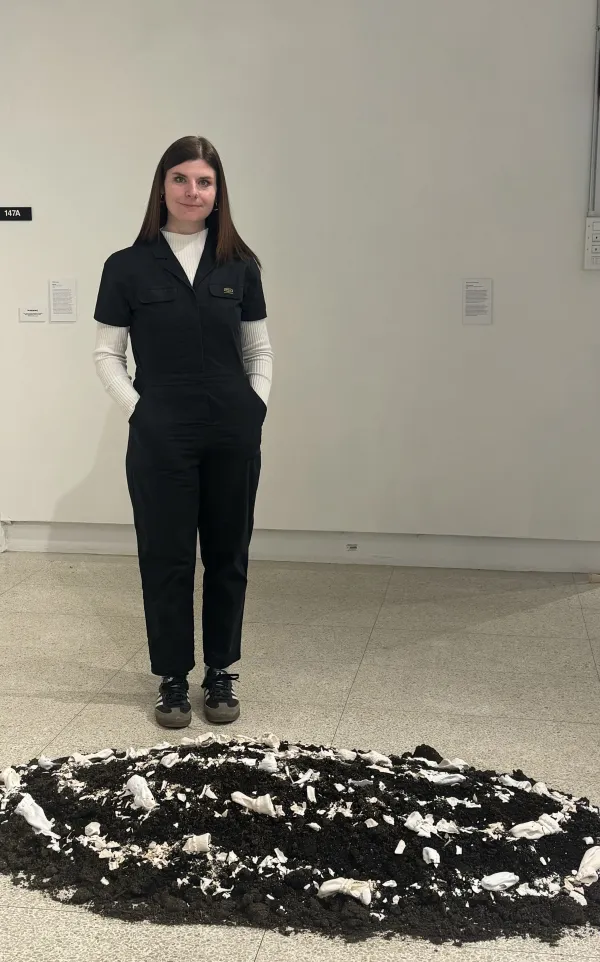
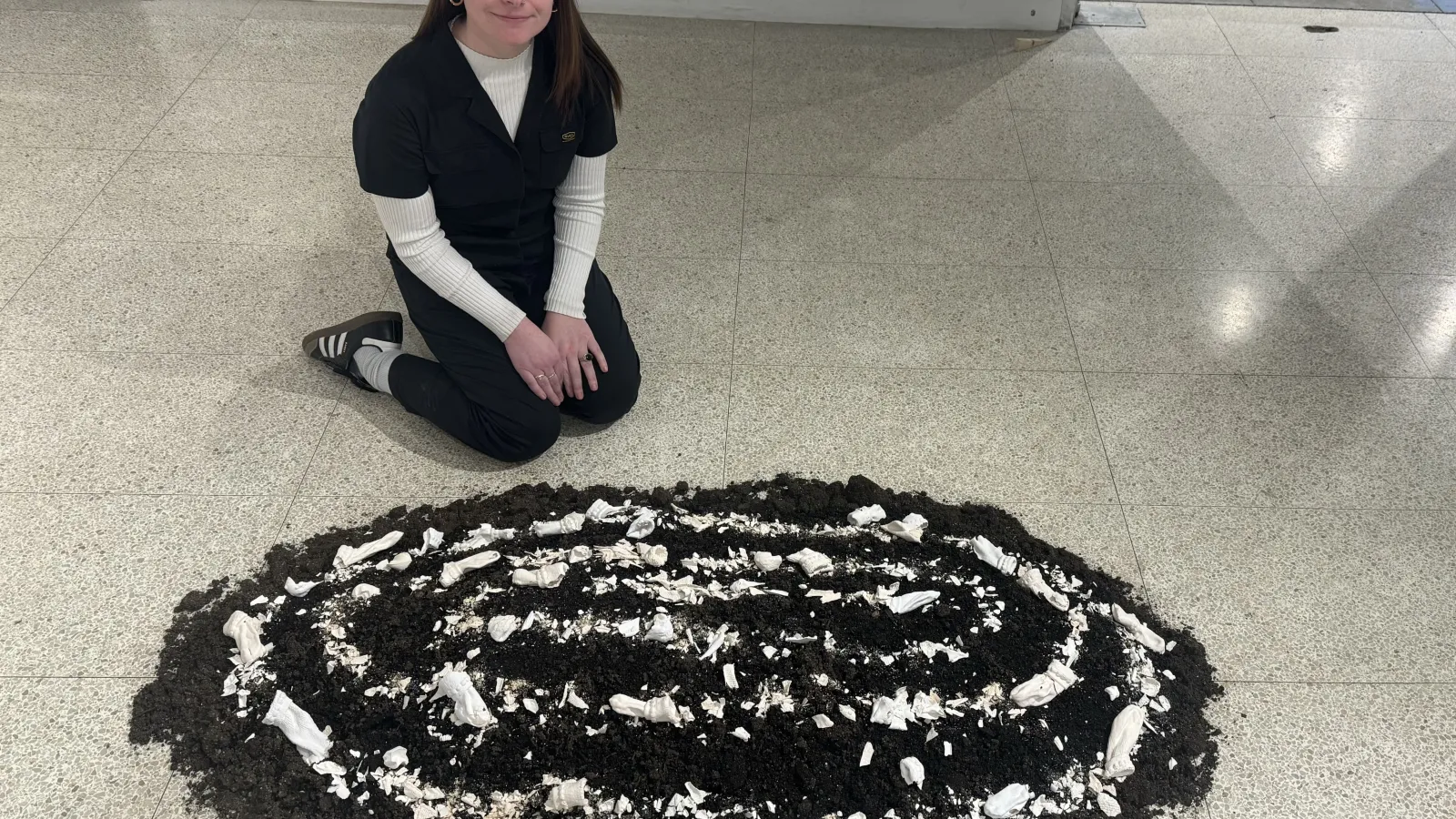
796 Innocents by Mia Sweeney Gahrmann takes its title from the 796 babies and young children whose remains were discovered in 2017 at the Tuam Mother and Baby Home in County Galway, Ireland. These children were born into a system that punished and shamed women, rendering their lives and deaths largely invisible. The work also engages with the history of Ireland’s Magdalene Laundries, institutions where women were coerced into confinement and forced labor, often for perceived moral failings, and where generations endured silence, stigma, and erasure.
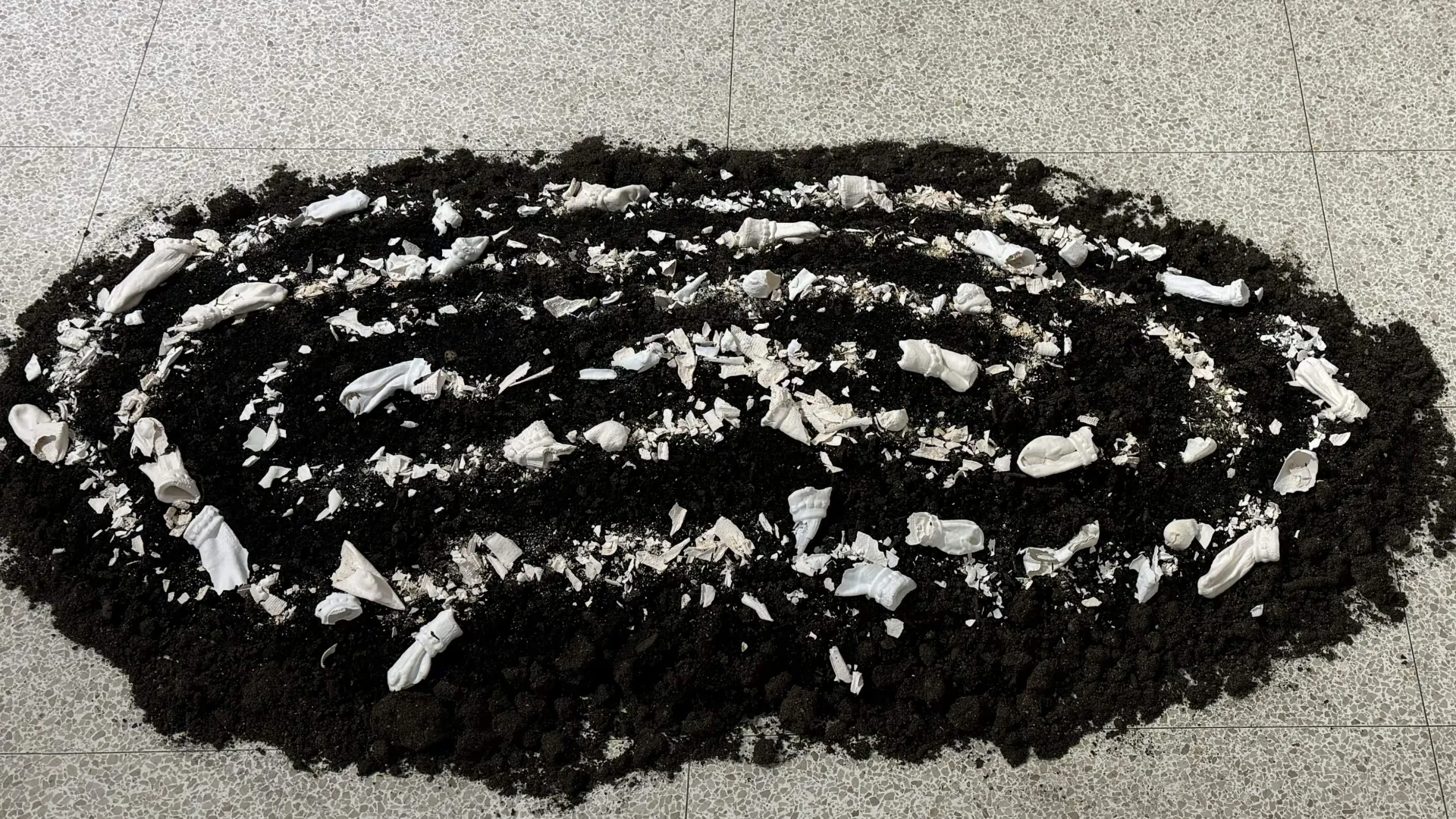
Through soil, crushed porcelain infant socks, and circular arrangements, Gahrmann’s installation holds absence as a form of presence. It offers a ceremonial space to remember those denied care, burial, and recognition, and to reflect on the lasting impact of these institutions on women, children, and families.
Gahrmann’s work is on view in Don't Leave the Back Door Unlocked at Hopkins Hall Gallery through February 13, 2026.
Soil is a strong visual and physical material here. What does the earth represent for you?
For me, soil is both a material and a witness. It holds what is buried, what is forgotten, and what refuses to disappear. In this work, the earth directly references the soil in Tuam, where the remains of infants and young children were found, bodies placed into the ground without ritual, record, or care. The soil becomes a site of containment, but also of exposure: it is what ultimately brought the truth to the surface.
Working with earth allows me to acknowledge the ground as a keeper of memory. It absorbs time, labor, and loss, carrying the weight of what these institutions attempted to erase. The porcelain infant socks rest within and on the soil as fragile counterpoints, made objects placed against a material that outlasts us. Together, they speak to burial and denial, but also to the possibility of reckoning. The earth here is not neutral; it demands attention. It asks us to consider what has been placed beneath our feet, and what responsibilities remain once those histories are uncovered.
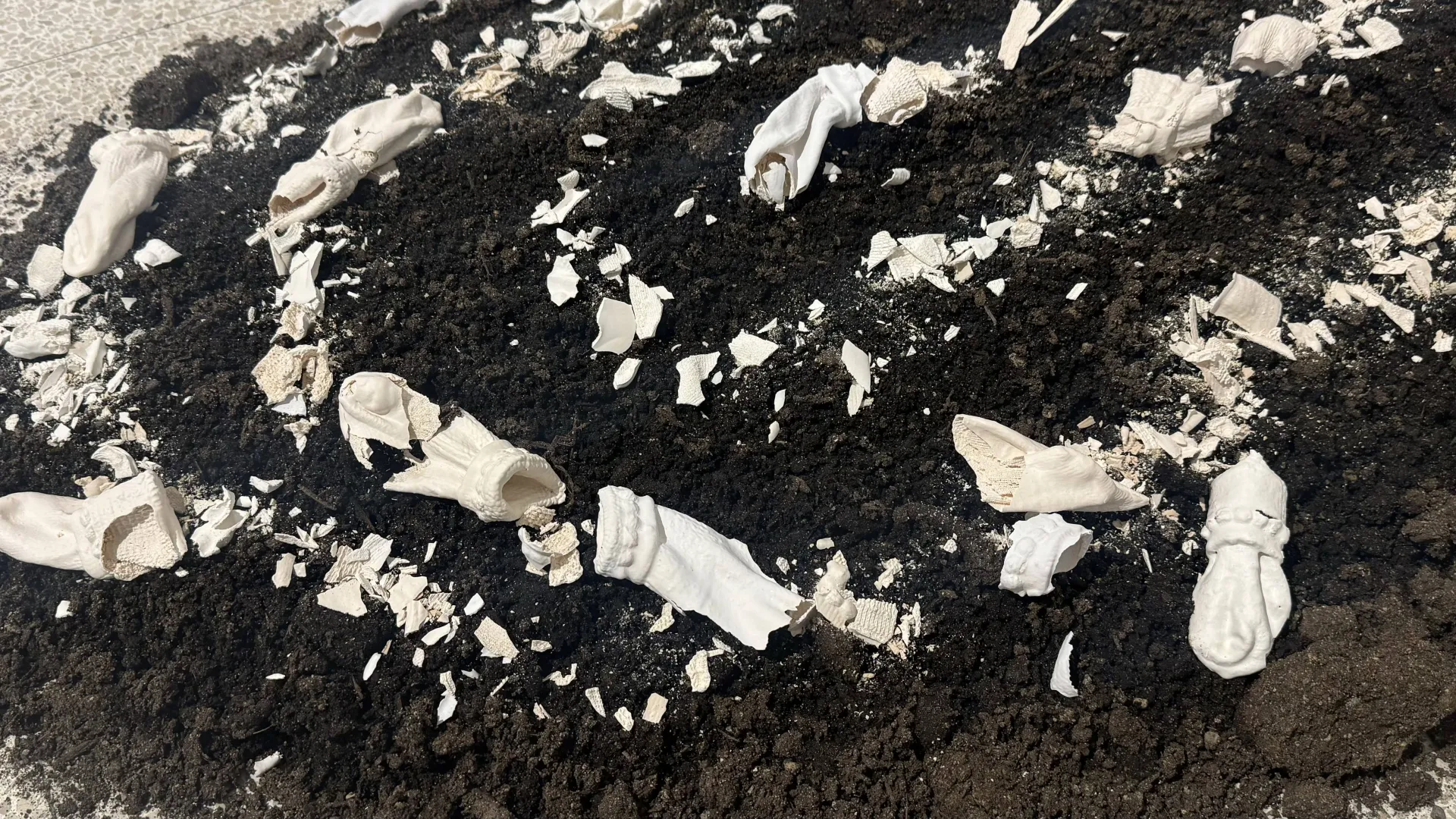
Some of the porcelain fragments look like fabric or clothing. Can you talk about this transformation from a soft material to a hard form?
Clothing begins as something intimate and protective, soft, flexible, shaped by touch and by the body it surrounds. In this work, that softness is translated into porcelain through slip-casting infant socks, a process that mimics care and repetition while quietly undoing it. The socks are first formed using fabric originals, which are saturated with porcelain slip. During firing, the fabric burns away entirely, leaving no trace of the original material. What remains is a thin porcelain shell: hollow, rigid, and fragile.
A material associated with warmth and care becomes brittle, breakable, and easily shattered. The fragility of the porcelain is not incidental; it is the result of the process itself. The firing both preserves and destroys, fixing the shape while erasing the material that once gave it life. In this way, the fragments hold the tension between protection and vulnerability, presence and loss, care and its withdrawal.
What was the process of making so many individual fragments like?
The process was slow, repetitive, and physically intimate. Because the work is site-specific, the fragments were created on site with the understanding that they would only exist in this form for the duration of the exhibition.
Crushing the porcelain socks by hand was a pivotal part of the process. It was both cathartic and emotionally difficult, bringing up a strong sense of loss. The act of breaking something that had been carefully made carried its own weight, echoing the violence of erasure while remaining grounded in a personal, embodied gesture. As the socks shattered, the fragments began to resemble ashes. That transformation, from whole to broken to nearly unidentifiable, became a way of acknowledging grief, impermanence, and the fragility of memory itself.
What do you hope viewers think about or feel when they stand in front of this installation?
The work asks viewers to slow down and sit with a sense of quiet reckoning. Rather than offering a single narrative or emotion, I want the installation to create a space where feelings of grief, tenderness, and unease can coexist.
I also hope the work raises awareness of the women and children who were confined within the Magdalene Laundries and related institutions, and of how recent this history truly is. The last Magdalene Laundry in Ireland only closed in 1996, and the remains of 796 infants and young children at the Tuam Mother and Baby Home were discovered as recently as 2017. These are not distant events; they continue to shape lives through intergenerational trauma, silence, and unresolved loss. Many survivors and families are still living with the consequences of these systems, and their stories remain insufficiently acknowledged.
At its core, the installation is meant to function as a kind of monument and ceremony for those 796 infants and young children, children who were denied proper care, burial, and remembrance. In a context where their lives were undocumented and their deaths unmarked, the work seeks to offer a gesture of care, however incomplete. It asks viewers to remember those who were deliberately forgotten, and to consider memory not as something that fades naturally, but as something that can be lost through neglect or preserved through collective responsibility.