Laura Da’s Poetry Collection “Severalty” Reflects on Indigenous Resilience
As someone who hasn’t touched a poetry book in years, my first glimpse into Laura Da’s newest poetry collection, Severalty, threw me for a loop. I will use the statement I often hear from my peers regarding American education: It completely failed me. My knowledge of Native American/Indigenous history and culture amounted to stereotypes and stories that were wildly in favor of the white American perspective. With that said, I couldn’t make any connection or understanding of Da’s Severalty after my first read through. I had not even understood what the word severalty meant. Upon the realization that I was out of my depth, I doubled down on this reading. I endeavored to learn the history and stories from Laura Da’s account.
Severalty, meaning “the condition of being separate,” examines the 1887 Dawes Severalty Act, which was maliciously designed to sever Indigenous people from their commonly held lands, sacred sites, community, and even their bodies and spirits. Severalty starts readers off with Da’ revisiting painful places where she collects stories, memories, and facts to repair what was shattered in the historical timeline. In Da’s poem “Strata,” she tells a family story:
that after the allotment act
one of my distant great-uncles,
refusing to sign
in the place
of a missing father,
was beaten so hard
he ran off
in the gloaming
bleeding a dark saddle pad
across the withers
of the fastest horse
in the barn.
In court papers, the horse,
a leggy red,
was considered adequate
compensation for the last
of the land
in its entirety.
Da’ draws attention to how people and place are inseparable, where severalty ripped people away from everything that gave meaning to their lives.
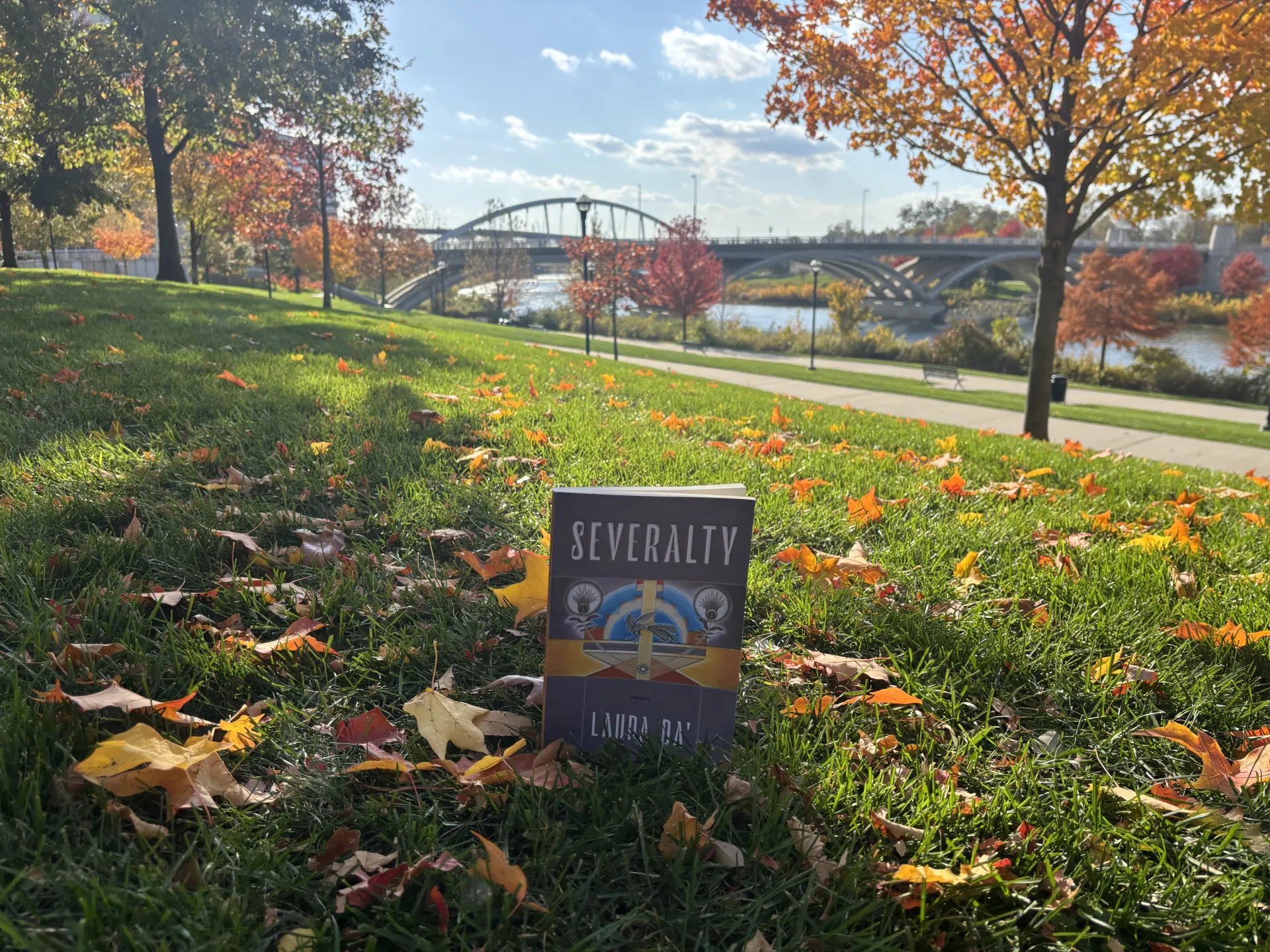
In the poem “Shawnee World for Principal City,” Da’ shares how the word Chillicothe stands for the thing it represents and the reciprocity between humans and the natural world that made the city possible:
In the case of Chillicothe,
the city is contingent
on the river whose flow
is one of the four chambers
of the name.
Da’ writes, “High banks to spare us deluge / … The principal city’s devastation / froths beneath the flood.”
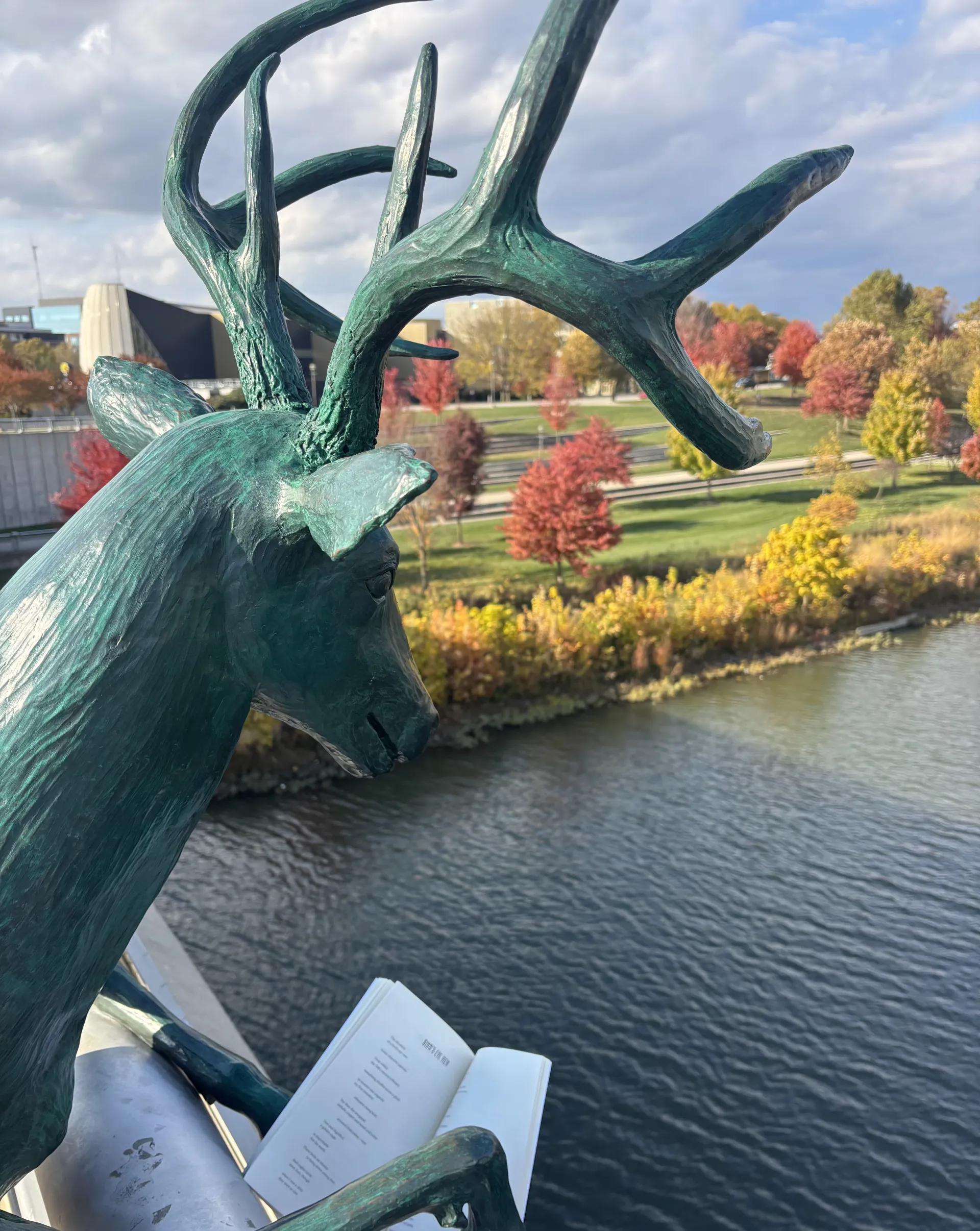
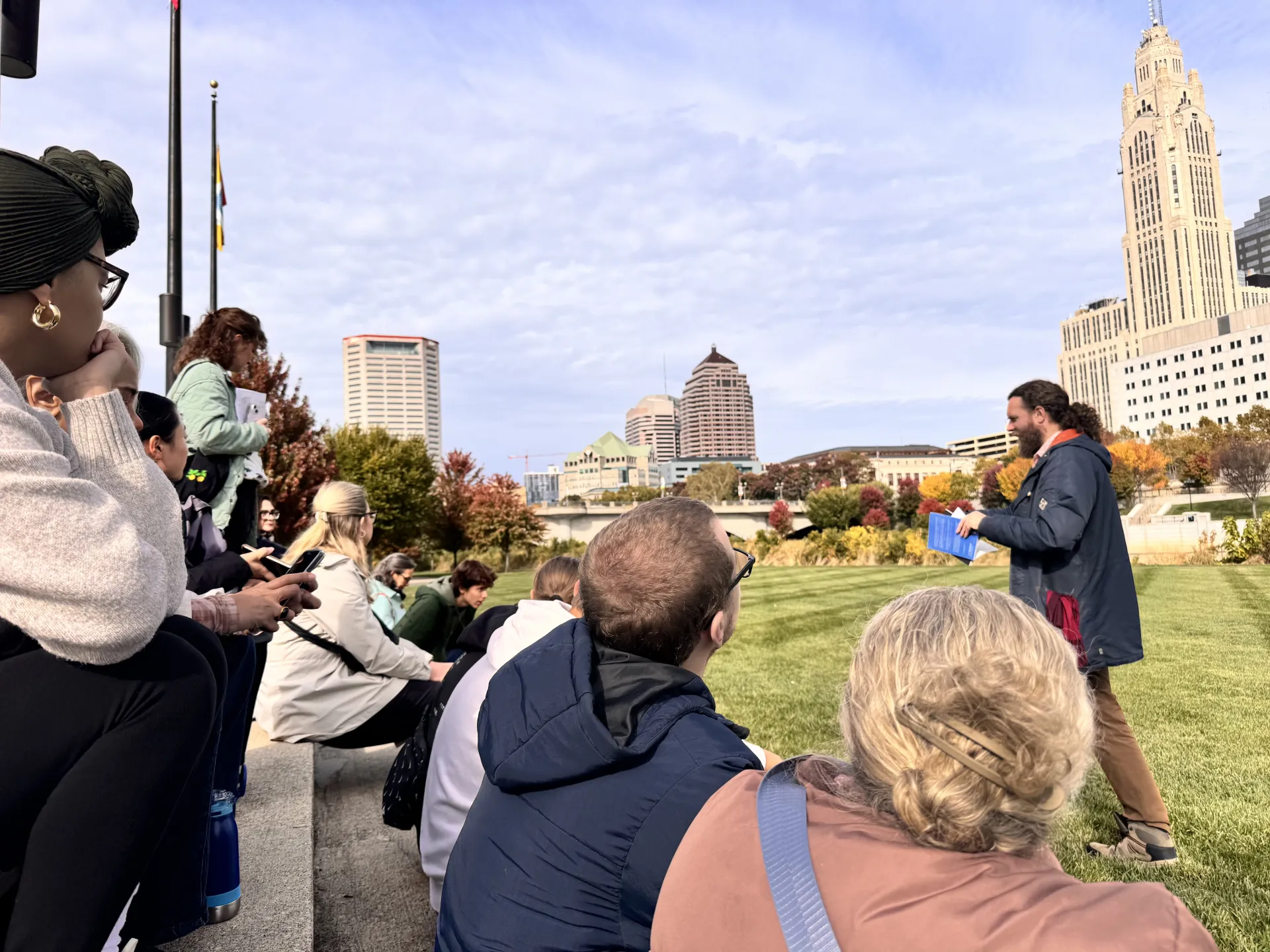
During Artist Commune: Poetry Walk with Professor Richard Finlay Fletcher—one of the organizers of the Laura Da’: Why Lazarus exhibition along with Marti Chaatsmith and Elissa Washuta—he took us down to the Scioto River, where he read selections from Da’s three poetry collections: tributaries (2015), Instruments of the True Measure (2018), and Severalty (2025), each published by the University of Arizona Press. I learned that Scioto means “hairy,” and the reason it was named the “Hairy River” was due to the deer that often gathered en masse and drank from the river, their hair falling into it as they drank.
As I was reading the poem “Painterly,” I came across the word catechized—“catechized until sedated: Will I be remembered?” I had to look up what this word meant. Catechized, in this instance, was recalling the history of many Indigenous people being forced to convert to Christianity. Upon recognizing this Christian indoctrination, I had started to notice a lot of Christian allusions woven into Da’s poems. Christian allusions are especially prominent in Da’s character Lazarus Shale. Here, the name Lazarus is heavily loaded; it features in the title for Da’s exhibition (Why Lazarus) and connects to both the Biblical character and Da’s Shawnee ancestral character. In an interview with Richard Finlay Fletcher regarding her exhibition—which was reproduced in the gallery guide—Da’ states, “I think of it as connected to this idea of the creation of ancestral honoring or composite that is both based in reality and utilizes an imposed name full of Christian connotations.”
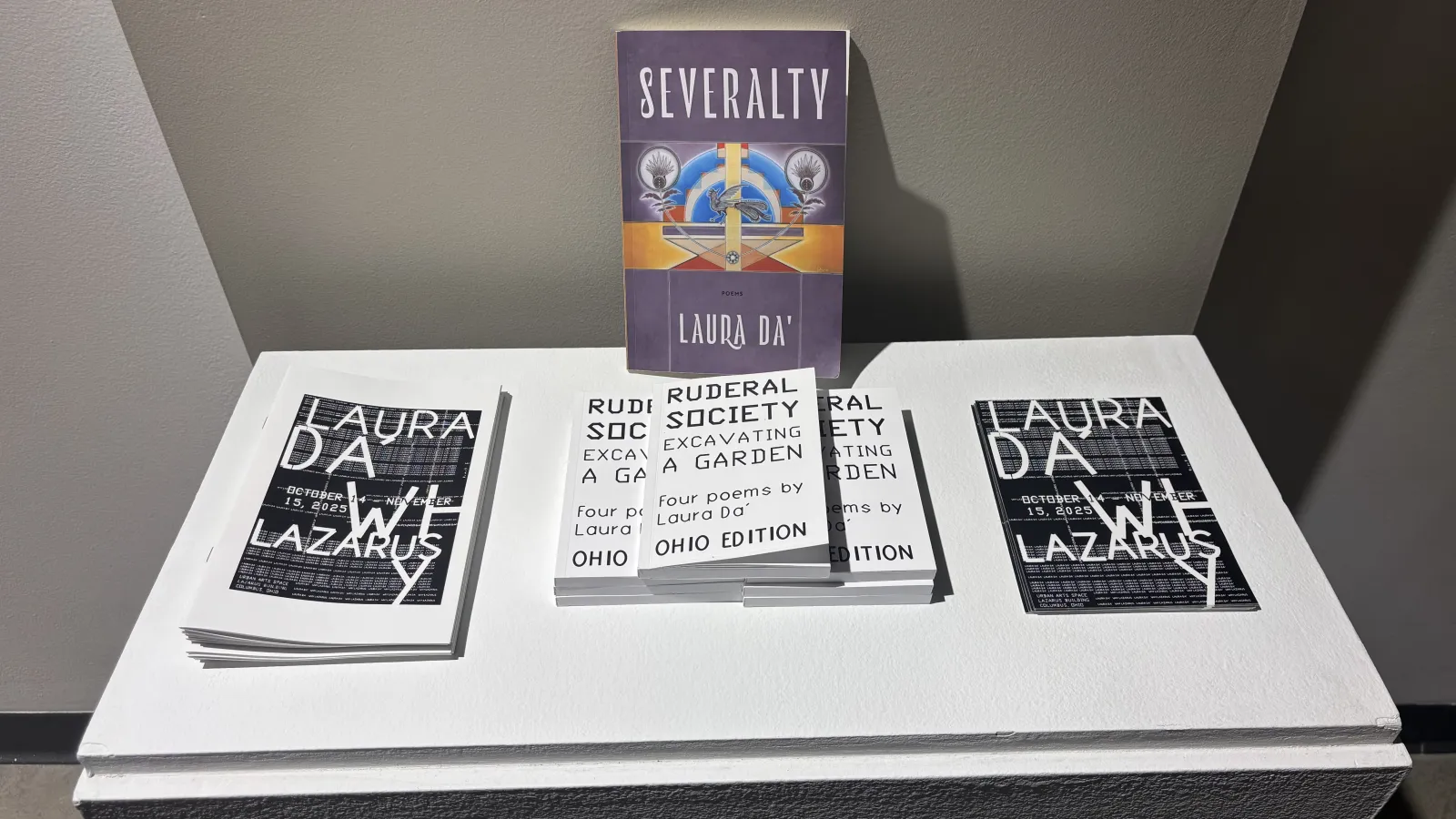
That interview helped me understand more about the symbolism and writing behind Da’s poetry. In the poem on display in the exhibition Why Lazarus, Da’ uses a slightly unusual form composed of stanzas that begin with a left-justified line followed by an indented line. When Da’ was creating this poem, she had been looking at ledgers—pieces of the historical record pertaining to Shawnee history. These ledgers often took on a visual format, which Da engaged with to create the form in her poem “Why Lazarus” in Severalty.
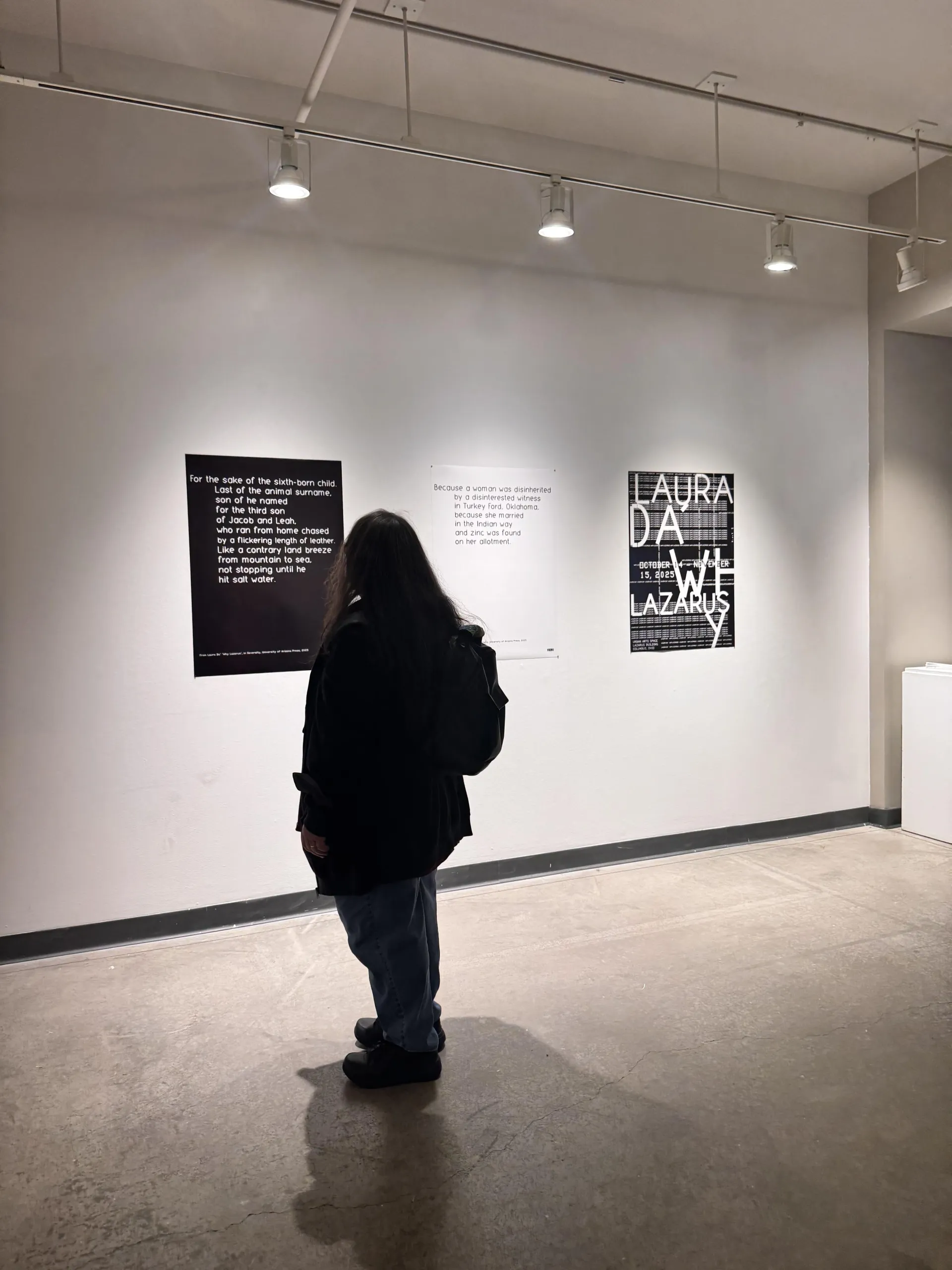
This poem was displayed along the entrance corridor to Urban Arts Space. I have walked past it many times, stood and read it, listened to Da’ herself speak one of the pivotal stanzas, but I had never truly engaged with it until I went on a poetry walk with Richard Finlay Fletcher, which was centered on Da’s collection of works. Inside Severalty, “Why Lazarus” sits between the pages as the forty-second poem out of the forty-six poems that make up the collection. Upon engaging with the poem through the poetry walk, I better understood the symbolism, the connection Da’ has with her Shawnee history, and how she compares her Shawnee world to perspectives from classical Western culture.
Da’s newest poetry collection Severalty and her Why Lazarus exhibition at Urban Arts Space allowed me to learn about Indigenous history from a firsthand account. Da’ has generously shared her exploration and research of her Shawnee history and personal reflections, giving me new insights that I am grateful to have had experienced.
Learn more about Laura Da’ on her website. Da’s poetry collections, including Severalty, are available for purchase in Columbus at the Wexner Center Store and Two Dollar Radio, as well as directly from the University of Arizona Press.