Building Community Through Art, Design, and Dialogue with Ukheon Jeong


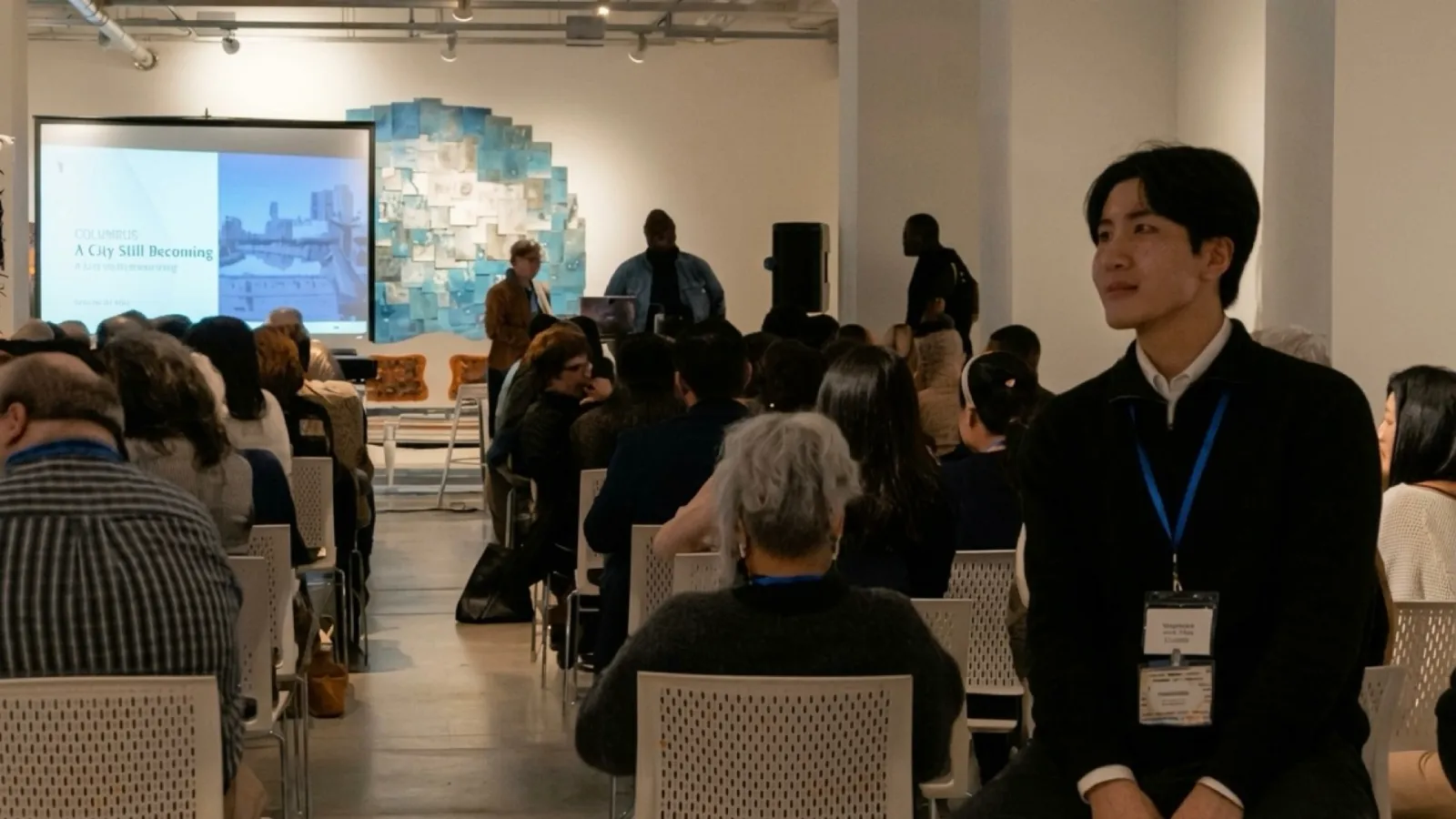
As a Communication Technology major at Ohio State, Ukheon Jeong enjoys figuring out how technology can make people’s lives more convenient, especially in the art industry. Ukheon, in his role as a Visual Communication Engagement Associate at Urban Arts Space, helped lead the Smithsonian Democracy in Dialogue program at Fort Hayes High School this past spring. The program featured a semester-long series of conversations about Hip Hop, graffiti, and breakdancing with high school students, led by Urban Arts Space staff, interns, and guest artists like Lance Johnson and DJ O Sharp. Ukheon facilitated sessions on community letter writing and took photo documentation, presenting the project at the 2026 Hip Hop Literacy Conference.
In addition, Ukheon recently presented his community-engaged design work at the international conference for Social Theory, Politics & the Arts alongside Urban Arts Space Director Dr. Terron Banner and Community Learning & Experience Specialist Dr. Xiaoxiao Bao on the topic “Participation by Design: Building Participatory Infrastructure Across Administration, Pedagogy, and Visual Communication in the University Gallery.”
Ukheon created a new project management tool designed for arts organizations to increase efficiency and workflows, which he customized for Urban Arts Space. This platform is based on a 30-page employee handbook that Ukheon converted into visual elements. UAS staff plan to begin using this new platform in the upcoming year to improve operations, all thanks to Ukheon’s hard work and ingenuity.
From Ukheon Jeong:
Coming from South Korea, the Democracy in Dialogue project allowed me to understand American culture strictly from the vantage point of an observer. As a witness and documentarian, I had the privilege of observing how local students view Columbus, exploring the thoughts they hold, and examining how their lived realities connect with Hip Hop culture. This experience provided me with profound personal and intellectual reflections.
I was not a teacher, but an observer granted permission to look inside. Rather than directing the students at Fort Hayes Career Center, my role focused on documenting and analyzing how they articulated ideas, engaged in dialogue, and interacted with one another. Through weekly session documentation, qualitative analysis of student writings, and presentations of our findings, I helped highlight the systematic qualitative research emerging from this project.
Hip Hop served as the primary connective tissue for this journey. Its five foundational elements (Knowledge, Graffiti, DJing, Breaking, and MCing) were not presented as abstract concepts, but as critical lenses through which students could discover the cultural practices already alive within their own neighborhoods. As students realized that their daily observations directly aligned with the vocabulary of Hip Hop, their personal narratives and collaborative exchanges blended naturally, bringing out the authentic voices within them.
Analyzing the 39 Dear Columbus letters brought a continuous series of revelations. The raw honesty that transcended their young age, paired with the organic way students from entirely different backgrounds arrived at the same emotional truth, offered deep insights for me as a Visual Communication Engagement Associate and an emerging researcher.
For these students, nature and trees were synonymous with home. They neither sanitized Columbus nor reduced it to its difficulties, choosing instead to face reality directly. Their ability to hold beauty and hardship together in the very same breath demonstrated that they testify to Columbus not merely as a physical backdrop, but as a living home rooted in their own cultural authority.
Presenting these invaluable records at the Hip Hop Literacy Conference felt like unearthing hidden gems from everyday life and sharing their true worth. What these students produced was the true essence of what Hip Hop defines as Knowledge, which is wisdom gained not from textbooks, but from being present and paying close attention. As an international observer experiencing and analyzing these values firsthand, the resonance of this journey will undoubtedly serve as a foundational milestone for my future academic path.
"Someone was here. Something was made. It mattered."
— Ukheon Jeong, Visual Communication Engagement Associate, Urban Arts Space